


For many, a good pair of binoculars is the sweet spot for their outdoor exploits. Admittedly, I fall into this group. I like the portability, as well as the ability to have one securely tethered to my chest with a chest pack.
However, as hunters, there is often a “bigger is better” mentality; bigger rifle calibers, bigger broadhead cutting diameter, and bigger space within a pop-up blind. While the notion is often misplaced (or at least overstated), it’s pretty hard not to ignore the sentiment for spotting scopes. It’s difficult to argue with the idea that choosing a spotting scope enhances image and video success in hunting, scouting, and a whole slew of other outdoor activities that beg for more magnification.
It should come as no surprise that spotting scopes continue to gain popularity for hunters and other avid outdoorsmen and women.
There are myriad reasons to ramp up your magnification with the use of a spotting scope. The good news is that you can achieve even more visual enlargement if you combine one with a smartphone camera – a method that pulls double duty by including a means of recording images. Luckily, you can build a custom kit in minutes by simply visiting the Phone Skope Builder Page.
Spotting Scope Basics
A spotting scope is a compact telescope designed largely for earthbound observation. Generally speaking, most spotting scopes offer power in the 15×45 to 20×60 range. However, you can find ones with magnification up to around 250x – a far cry from your go-to set of 10×42 binos. Their size and design require tripods and truck window mounts for stability.
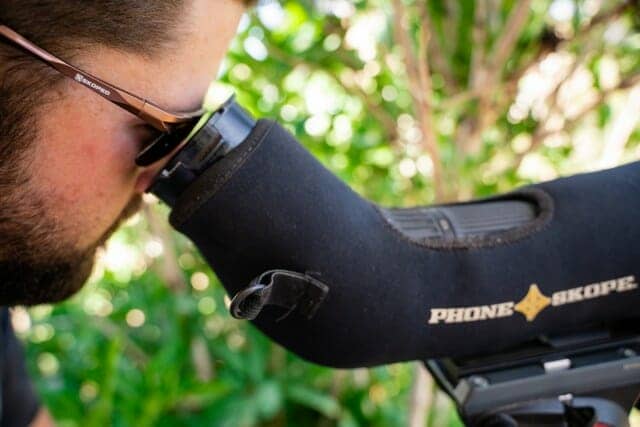
There are a couple of popular designs; an angled scope which provides a higher eye point and is good for sharing the visual experience with others.
Causing less tension on the neck, straight spotting scopes are ideal for viewing animals on the hoof or at ground level.

Popular spotting scope types include angled (left) and straight (right) spotting scopes.
Note that the main drawbacks of spotting scopes are the decreased field of view compared to binoculars or monoculars, as well as added neck and eye strain.
Hunting, Stalking, and Scouting
Spotting scopes is a great tool for any visual opportunity requiring a boost in power. Again, digiscoping ups the ante through even more magnification and the ability to capture helpful and interesting subjects on your smartphone device. This super-combo is great news for birdwatchers and other outdoor enthusiasts.
For me and many others, digiscoping with a spotting scope is about improving hunting success by locating and pursuing deer and other game animals. The spotting scope-digiscoping combo helps to capture and document travel patterns and animals with distinguishing traits. The image enlargement that is produced by using both a spotting scope and digiscoping kit also comes in handy for locating particular animals out of a group or herd or differentiating between species.

Spotting scope digiscoping leverages the long-range capabilities of both digiscoping and the scope itself.
This helps me to plan future hunts or, sometimes, embark on a stalk of a distant shooter buck. Heck, spotting scope digiscoping is even a great way to capture bullet groups on targets for long-range shooters.
If you tend to your scent and pick locations and setups that offer good concealment, digiscoping with a spotting scope offers a smaller outdoor footprint than other scouting methods such as trail camera deployment, which often requires return trips to ground zero – those sweet spots in the belly of your hunting grounds. The bottom line is that the extra magnification offered by this method is ideal for hunting elusive and wary animals such as whitetails, elk, and wild sheep.
Picking Your Spotting Scope for Digiscoping
Whether you digiscope in the local park or venture deep into the backcountry, a spotting scope is a sure way to open new digiscoping opportunities.
First off, you don’t have to stretch your budget too far if you don’t want to. Spotting scopes come at various price points and, if taken care of properly, can provide long-range digiscoping success for life.

Digiscope scouting with a spotting scope allows you to more clearly see and capture animal characteristics such as antler points.
However, with outdoor use comes heat, moisture, and sometimes the drops. At a minimum, seek scopes with tough and waterproof construction. Remember, optics that are chock-full of nitrogen go a long way toward avoiding fogging of the lens.
Finally, if you plan on hoofing it, seek a scope that’s not on the heavy end. Get a good tripod, as well as a backpack or other bag that can effectively house the scope, tripod, and digiscoping gear.
Binoculars; the Downsized Sidekick
While spotting scopes have advantages over binos, single-eye viewing can cause both eye and neck strain. Hence, pack a set of binoculars as well. Of course, you can also pack a digiscoping adapter kit with them too. One good strategy is to use binoculars for initial surveying of the area or actual subject. Once you’ve identified the desired subject, switch to the spotting scope digiscoping setup for enhanced clarity and visual amplification.
It’s hard to beat the ability to pull in distant images with a spotting scope and, with the use of a good tripod or car window mount, they provide a steadier viewing experience.
Add digiscoping to this already robust form of nature observation and you have a one-two punch that will enhance your outdoor viewing experience. And remember, thanks to this unique form of photography, you’ll be able to share your visual wares right from your smartphone. Best of luck on your next (or first) digiscoping quest with a spotting scope.